


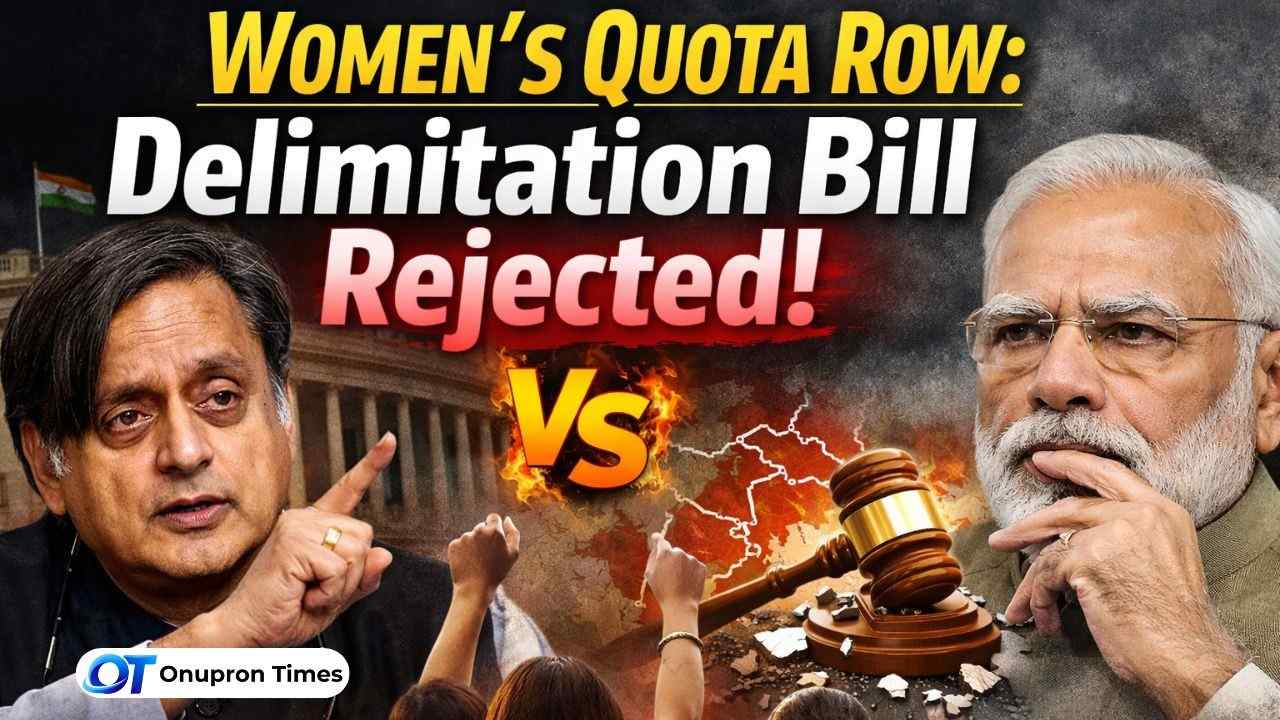
Women Reservation Bill: A constitutional amendment bill—aimed at implementing the reservation of seats for women in the legislature starting in 2029 and increasing the total number of seats in the Lok Sabha—was defeated in the Lower House on Friday (April 17, 2026). While 298 members voted in support of the bill, 230 Members of Parliament voted against it. The bill was defeated due to its failure to secure the requisite two-thirds majority.
Subsequently, the Central Government announced that it would not proceed with two other related bills; the government argued that these bills could not be viewed in isolation or treated separately. Expressing disappointment over the bill’s defeat, Parliamentary Affairs Minister Kiren Rijiju stated that this represented a missed opportunity to build consensus on a crucial reform.
In a major political development, the Lok Sabha has rejected the Constitution (131st Amendment) Bill, 2026—derailing the government’s attempt to fast-track women’s reservation and redraw parliamentary constituencies together.
What was the 131st Amendment Bill about?
The proposed amendment was not a standalone reform. It was part of a broader legislative package that aimed to:
- Expand the strength of the Lok Sabha significantly
- Enable fresh delimitation (redrawing of constituencies)
- Link the implementation of women’s reservation to this delimitation exercise
Delimitation, in simple terms, is the process of redrawing electoral boundaries based on population data so that representation remains balanced.
The bill also attempted to move away from the current system—where seat allocation is frozen based on older census data—and instead allow Parliament to decide when and how delimitation should happen.
Women Reservation Bill: Why did the bill fail?
Despite getting majority support, the amendment failed because it did not secure the required two-thirds majority needed for constitutional changes in Parliament.
Reports indicate that hundreds of MPs supported the bill, but opposition unity and concerns over its implications ultimately blocked its passage.
As a result, not just the amendment—but also the associated delimitation plans—have now been shelved for the time being.
The core controversy: Linking women’s quota with delimitation
The biggest political flashpoint was the government’s decision to tie women’s reservation to delimitation.
While the 106th Constitutional Amendment (passed earlier) already guarantees 33% reservation for women, its implementation was made conditional on:
- A fresh Census
- A delimitation exercise based on the Census
This effectively means the quota cannot come into force immediately.
Critics argued that this linkage could delay the policy by years.
Women Reservation Bill: Shashi Tharoor’s sharp criticism
Senior Congress leader Shashi Tharoor emerged as one of the most vocal critics of the move. He described the linkage as:
- A “political demonetisation.”
- A “gift wrapped in barbed wire.”
According to him, women’s reservation already enjoys broad political consensus and should be implemented immediately—without being tied to complex processes like delimitation.
He warned that combining the two issues risks delaying justice for women and turning a widely supported reform into a prolonged political battle.
Why delimitation is a sensitive issue
Delimitation is not just a technical exercise—it has deep political consequences.
- It can change the number of seats each state gets in Parliament
- States with higher population growth could gain more seats
- Others, especially in southern India, could see reduced representation
This creates concerns about federal balance and political equity, making delimitation one of the most debated issues in Indian politics.
Related Article: Lenskart Hijab Bindi Controversy | Why Lenskart Being Anti-Hindu? – Company Clarified
Women Reservation Bill: What happens next?
With the bill rejected:
- The proposed expansion of Lok Sabha seats is on hold
- The delimitation exercise has been temporarily shelved
- The timeline for women’s reservation remains uncertain
In practical terms, this means the 33% quota for women is unlikely to be implemented in the immediate future, especially before the next general election cycle.
The bigger picture
This episode highlights a deeper political divide:
- Government’s view: Structural reforms (like delimitation) are necessary before implementing reservations properly
- Opposition’s view: Women’s representation should not be delayed by procedural or political conditions
For now, the result is a legislative deadlock. But the debate has only intensified—and it is likely to remain a central political issue in the coming years.
Know More: https://en.wikipedia.org/wiki/One_Hundred_and_Sixth_Amendment_of_the_Constitution_of_India
