


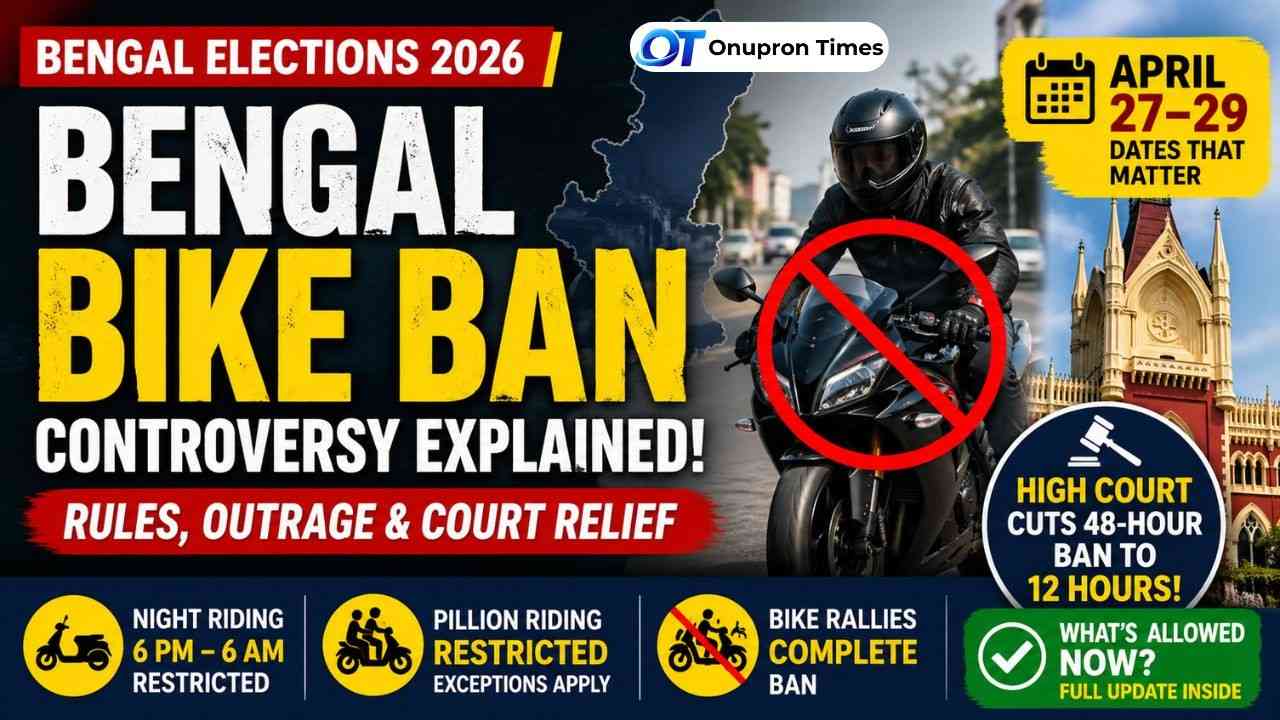
Kolkata Bike Restrictions April 27–29: To ensure a peaceful Assembly election, the Kolkata Police has imposed a series of restrictions on motorcycle movement across the entire city and its adjoining areas—including parts of South 24 Parganas.
Issued by Police Commissioner Ajay Nand in pursuance of directives received from Chief Electoral Officer Manoj Kumar Agarwal, this order will come into effect at 6:00 AM on April 27 and will remain in force until the completion of the election process.
As West Bengal heads into the crucial second phase of the 2026 Assembly elections (April 29), a controversial set of restrictions on two-wheelers has triggered confusion, protests, and eventually a legal rethink. What started as a strict Election Commission order quickly turned into a major public issue across Kolkata and beyond.
Kolkata Bike Restrictions: Why Were Bikes Restricted in the First Place?
Ahead of polling, authorities — including the Election Commission and Kolkata Police — introduced strict rules on motorcycles and scooters.
The objective was simple:
to ensure a “free, fair and violence-free election” by limiting the movement of groups that could intimidate voters.
Key Original Restrictions:
- No bike movement at night (6 PM – 6 AM)
- Ban on pillion riding during daytime (6 AM – 6 PM), with limited exceptions
- Complete ban on bike rallies
- Restrictions applied from April 27 to April 29 (polling day)
Authorities argued that motorcycles had historically been used for intimidation, rapid mobilization, and disruption during elections.
Kolkata Bike Restrictions: Why Did People Oppose the Ban?
The reaction was immediate and intense.
Daily commuters, gig workers, and ordinary residents said the restrictions:
- Disrupted essential services like food delivery and medicine supply
- Affected office travel and daily life
- Penalized common citizens instead of targeting troublemakers
Public anger grew quickly, forcing officials to reconsider the blanket nature of the restrictions.
Even political voices and civil society groups questioned whether the move was too extreme and poorly targeted.
High Court Steps In: Big Relief for Riders
The turning point came when the Calcutta High Court intervened.
It questioned the logic of a blanket ban and asked why only bikes were being targeted when other vehicles could also be misused.
What the Court Changed:
- Reduced the 48-hour blanket ban significantly
- Allowed general bike movement with conditions
- Limited strict restrictions to polling day (April 29)
Related Article: Election Exit Poll WB and Tamil Nadu 2026 | Record-Breaking Voter Turnout Marks a Turning Point in India’s 2026 Elections
Kolkata Bike Restrictions: New Rule After Court Order:
- Only a 12-hour restriction on polling day
- Pillion riding is still restricted, except for:
- Medical emergencies
- School transport
- Family functions
However, one rule remained unchanged:
- Bike rallies remain completely banned for security reasons
Download Order PDF: Click Here
Ground Reality: Restrictions Still Affect Daily Life
Even after the relaxation, the situation isn’t entirely normal.
Residents across Bengal are still facing:
- Transport disruptions (many buses and cabs diverted for election duty)
- Reduced mobility in sensitive areas
- Confusion about what is allowed and what isn’t
In some regions, additional restrictions—like limiting tourist movement near polling zones—have added to the inconvenience.
The Bigger Picture: Security vs Everyday Freedom
This episode highlights a familiar tension during elections:
- Authorities prioritize security and order
- Citizens expect minimal disruption to daily life
The Election Commission intended to prevent violence, but the initial approach raised a key question:
How far can restrictions go without affecting ordinary people?
The High Court’s intervention effectively tried to strike a balance—tightening security without imposing a blanket shutdown on mobility.
