


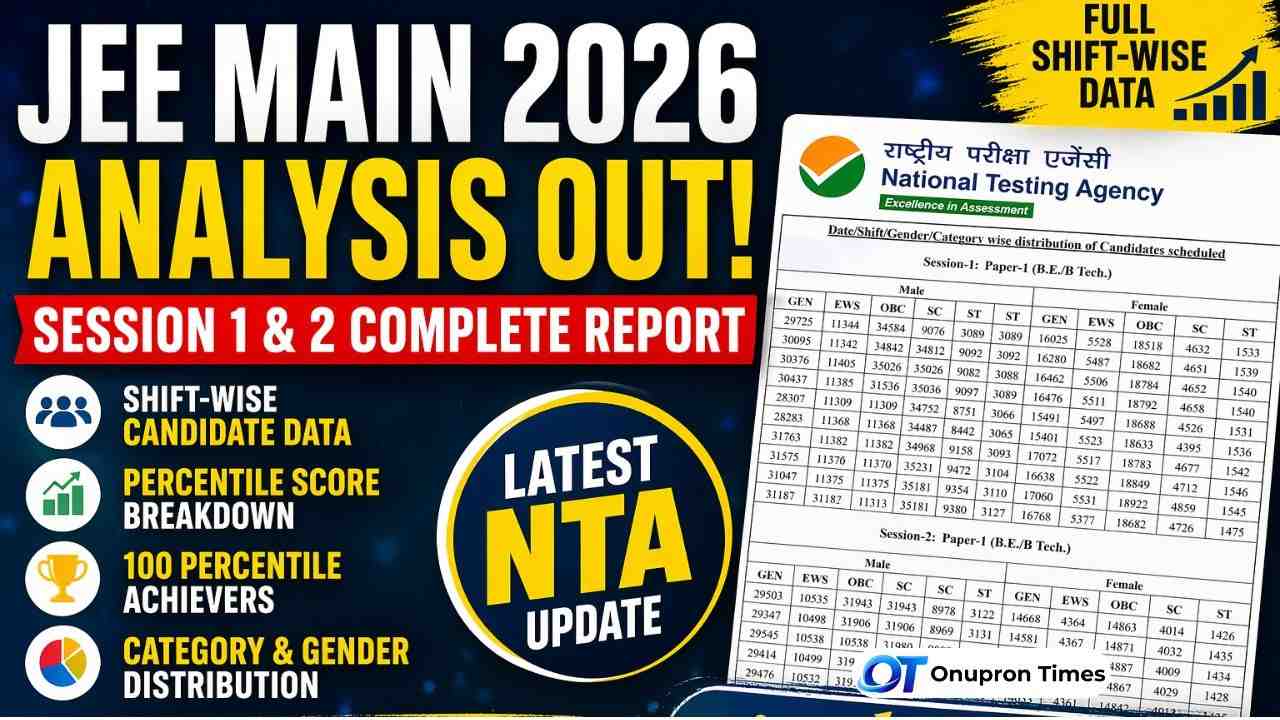
JEE Main 2026 Analysis Out (Session 1 and 2): The National Testing Agency (NTA) has released a notification for the official analysis of JEE (Main) 2026 covering both Session 1 (January) and Session 2 (April). The document provides deep insights into candidate distribution, shift-wise performance, and percentile score ranges, giving students a clear picture of competition trends this year.
This is one of the most comprehensive datasets released by NTA in recent years, aimed at maintaining transparency in the examination process.
JEE Main 2026 Analysis Out (Session 1 and 2): Official Announcement Highlights
According to the public notice dated 23 April 2026, the NTA has shared:
- Date-wise and shift-wise candidate distribution
- Gender and category-wise participation
- Percentile score analysis for each shift
- Overall transparency data for both sessions
Candidates are advised to check updates on the official NTA website for further details.
JEE Main 2026 Exam Schedule Overview
Session 1 (January 2026)
- Conducted from January 21 to January 28, 2026
- Two shifts per day (S1 & S2)
Session 2 (April 2026)
- Conducted from April 2 to April 8, 2026
- Similar multi-shift format
Each shift had a balanced allocation of candidates to ensure fairness across sessions.
JEE Main 2026 – Candidate Distribution (Session 1 & 2)
Session 1: Paper 1 (B.E./B.Tech.)
| Exam Date | Shift | Male GEN | Male EWS | Male OBC | Male SC | Male ST | Female GEN | Female EWS | Female OBC | Female SC | Female ST | Total |
|---|---|---|---|---|---|---|---|---|---|---|---|---|
| 21-01-2026 | S1 | 29725 | 11344 | 34584 | 9076 | 3089 | 16025 | 5528 | 18518 | 4632 | 1533 | 134054 |
| 21-01-2026 | S2 | 30095 | 11342 | 34812 | 9092 | 3092 | 16280 | 5487 | 18682 | 4651 | 1539 | 135072 |
| 22-01-2026 | S1 | 30376 | 11405 | 35026 | 9082 | 3088 | 16462 | 5506 | 18784 | 4652 | 1540 | 135921 |
| 22-01-2026 | S2 | 30437 | 11385 | 35036 | 9097 | 3089 | 16476 | 5511 | 18792 | 4658 | 1540 | 136021 |
| 23-01-2026 | S1 | 28307 | 11309 | 34752 | 8751 | 3066 | 15491 | 5497 | 18688 | 4526 | 1531 | 131918 |
| 23-01-2026 | S2 | 28283 | 11368 | 34487 | 8442 | 3065 | 15401 | 5523 | 18633 | 4395 | 1536 | 131133 |
| 24-01-2026 | S1 | 31763 | 11382 | 34968 | 9158 | 3093 | 17072 | 5517 | 18783 | 4677 | 1542 | 137955 |
| 24-01-2026 | S2 | 31575 | 11370 | 35231 | 9472 | 3104 | 16638 | 5522 | 18849 | 4712 | 1546 | 138019 |
| 28-01-2026 | S1 | 31047 | 11375 | 35181 | 9354 | 3110 | 17060 | 5531 | 18922 | 4859 | 1545 | 137984 |
| 28-01-2026 | S2 | 31187 | 11313 | 35181 | 9380 | 3127 | 16768 | 5377 | 18682 | 4726 | 1475 | 137216 |
Session 2: Paper 1 (B.E./B.Tech.)
| Exam Date | Shift | Male GEN | Male EWS | Male OBC | Male SC | Male ST | Female GEN | Female EWS | Female OBC | Female SC | Female ST | Total |
|---|---|---|---|---|---|---|---|---|---|---|---|---|
| 02-04-2026 | S1 | 29503 | 10535 | 31943 | 8978 | 3122 | 14668 | 4364 | 14863 | 4014 | 1426 | 123416 |
| 02-04-2026 | S2 | 29347 | 10498 | 31906 | 8969 | 3131 | 14581 | 4367 | 14871 | 4032 | 1435 | 123137 |
| 04-04-2026 | S1 | 29545 | 10538 | 31980 | 9008 | 3124 | 14685 | 4362 | 14887 | 4009 | 1434 | 123572 |
| 04-04-2026 | S2 | 29414 | 10499 | 31917 | 8981 | 3116 | 14589 | 4374 | 14867 | 4029 | 1428 | 123214 |
| 05-04-2026 | S1 | 29476 | 10532 | 31910 | 8994 | 3115 | 14633 | 4361 | 14842 | 4013 | 1435 | 123311 |
| 05-04-2026 | S2 | 29324 | 10559 | 31971 | 9008 | 3122 | 14506 | 4369 | 14811 | 4022 | 1417 | 123109 |
| 06-04-2026 | S1 | 29472 | 10539 | 31923 | 9006 | 3167 | 14663 | 4361 | 14855 | 4012 | 1465 | 123463 |
| 06-04-2026 | S2 | 29511 | 10554 | 31993 | 9011 | 3215 | 14633 | 4360 | 14854 | 4010 | 1464 | 123605 |
| 08-04-2026 | S2 | 29710 | 10533 | 32119 | 9040 | 3118 | 14740 | 4385 | 14935 | 4060 | 1437 | 124077 |
Massive Participation Across India
The PDF reveals that lakhs of candidates appeared across multiple shifts, with each session hosting over 1.2 to 1.3 lakh candidates per shift on average.
For example:
- 24 Jan 2026 (Shift 2) saw around 1.38 lakh candidates
- Even the lowest participation shifts had over 1.23 lakh candidates
This shows how competitive JEE Main 2026 remains.
Category & Gender Distribution
The report includes a detailed breakdown of candidates by:
- General (GEN)
- EWS
- OBC
- SC
- ST
- Male & Female participation
Key takeaway:
- Male candidates still dominate participation numbers
- Female participation remains strong and steadily increasing
- OBC category forms a significant portion of the total candidates
Check JEE (Main) 2026 Session 1 & Session 2 Date and Shift-Wise Percentile Score: Click Here
Related Article: JEE Main 2026 Session 2 Results Declared | Cut-Off, Toppers List, Direct Link
100 Percentile Achievers: Shift-wise Breakdown
One of the most important highlights is the distribution of top scorers (100th percentile).
- Almost every shift had at least one candidate scoring in the 100th percentile
- Some shifts had multiple toppers (up to 3 in a single shift)
This indicates:
- Balanced difficulty across shifts
- No major normalization advantage in any specific shift
Percentile Score Distribution Explained
The percentile formula used by NTA:
Percentile Score = (Number of candidates with score < yours / Total candidates in that shift) × 100
This ensures fairness across multiple shifts.
JEE Main 2026 Analysis: Key Percentile Ranges (Session 1 Insights)
From the detailed tables:
- 99+ percentile: 1300 candidates per shift
- 98–99 percentile: 1300 candidates
- 97–98 percentile: 1300 candidates
This pattern continues consistently, showing:
- Even distribution across score bands
- Highly competitive top percentile brackets
Lower percentile ranges (below 90) show increasing candidate density, meaning most students fall in the mid-range scores.
Important Trends from the Data
- Competition Remains Extremely High
Even a small percentile difference represents thousands of candidates.
- Shift Normalization Works Effectively
Consistent topper distribution proves no shift had an unfair advantage.
- Score Clustering Around Mid Percentiles
Most candidates fall between 70–90 percentile, making rank jumps highly competitive.
- Top Percentile is Very Narrow
Only a small fraction reaches the 99+ percentile, highlighting elite performance.
What This Means for Students
- A 99th percentile is still not a guaranteed top rank
- Even a 1 percent difference can change the rank significantly
- Preparation strategy must focus on accuracy + consistency
