


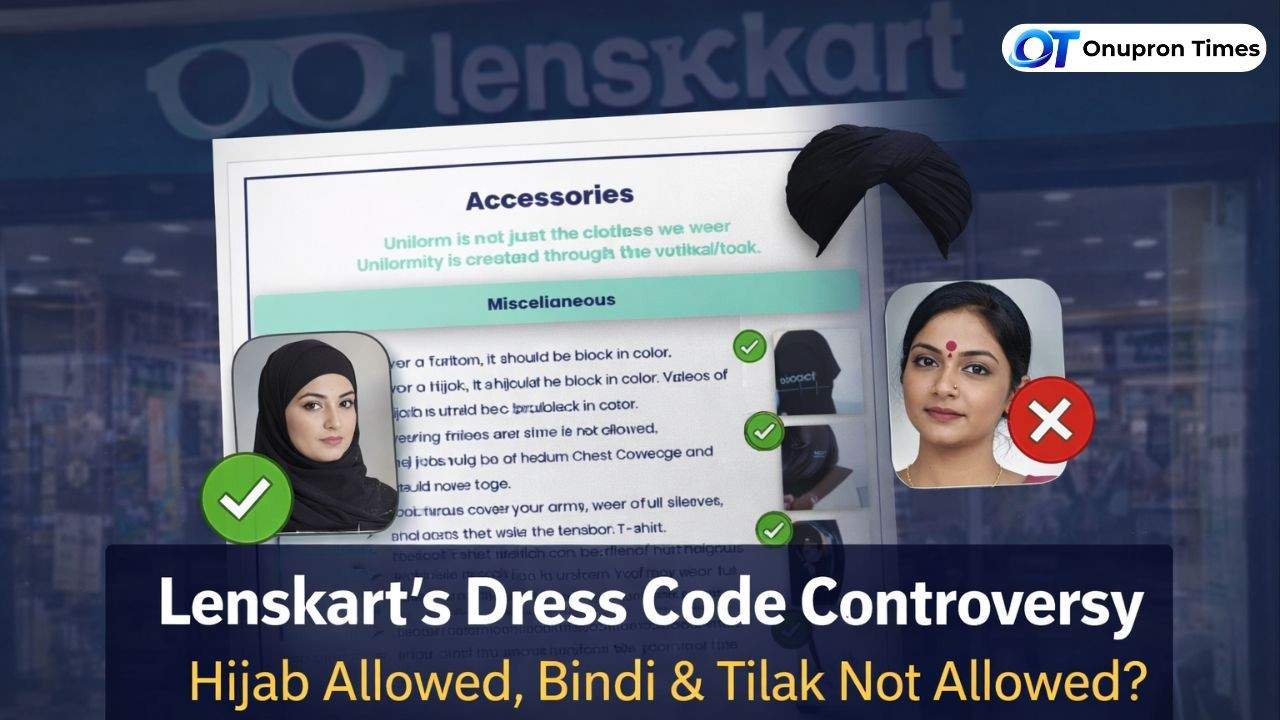
Lenskart Hijab Bindi Controversy: A fresh controversy involving eyewear giant Lenskart has triggered a nationwide debate on workplace policies, religious expression, and corporate sensitivity. Lenskart founder Peyush Bansal has refuted allegations claiming that, under the company’s current ‘Style Guide,’ employees are permitted to wear hijabs but are not allowed to wear bindis, tilaks, or kalawas. A controversy regarding alleged religious discrimination erupted yesterday following the online circulation of the “Lenskart Staff Uniform and Grooming Guide,” prompting Bansal to issue a clarification on the matter.
What began as a viral internal document quickly escalated into a social media storm. Our website, ‘Onupron Times’, provides you with a clear explanation of what actually happened.
Lenskart Hijab Bindi Controversy: Why Lenskart Being Anti-Hindu? -What Triggered the Controversy
The issue started when a document titled “Lenskart Staff Uniform and Grooming Guide” began circulating online. The document appeared to suggest that employees were not allowed to wear religious symbols like bindi, tilak, sindoor, or kalawa, while permitting items such as black hijabs and turbans.
This perceived inconsistency led to immediate backlash. Social media users questioned why certain religious expressions seemed acceptable while others were restricted. Many called the policy discriminatory and culturally insensitive.
The controversy gained traction rapidly, turning into a larger conversation about equality and inclusivity in corporate environments.
Lenskart ‘Style Policy’ (Accessories – Miscellaneous):
A viral post claims that a screenshot from Lenskart’s internal “style policy document” shows that hijab is allowed, but bindi, sindoor, and kalawa are not permitted.
- If you wear a Turban, it should be black in color.
- If you wear a Hijab, it should be black in color. Videos of hijab tutorials would be circulated for ease.
- Wearing a Burkha at the store is not allowed.
- The Hijab should be of medium chest coverage and should not cover the logo.
- If you choose to cover your arms, wear a full-sleeved, fitted black T-shirt under the Lenskart T-shirt.
- Avoid visible tattoos, which can offend/hurt religious sentiments.
- If visible, you may wear a full sleeve T-shirt under the uniform.
- All staff must carry a Bluetooth headset inside the store.
- Metal hairbands are allowed to look neat.
- Use a thin hair net to give a sleek look to the bun if the hair is frizzy/untidy.
- Applying Henna is not allowed. If required for a special occasion, it must be applied after prior approval of the PE Team and OM for a maximum of 10 days.
- Religious tikka/tilak and bindi/sticker are not allowed.
- Tongue piercing / face piercing is not allowed.
- Pregnant staff may wear loose jeans / comfortable jeggings with a T-shirt.
- Wearing any kind of cap/hat is not allowed.
Lenskart Hijab Bindi Controversy: Why People Reacted So Strongly
At the heart of the outrage was a simple question:
Can a company selectively allow some religious symbols while restricting others?
For many, the viral document appeared to do exactly that. Critics argued that such a policy, if true, would contradict India’s diverse cultural fabric and workplace inclusivity standards.
The debate wasn’t limited to religion. It also touched on broader issues like:
- Corporate control over personal identity
- Cultural representation at work
- Double standards in dress codes
This is why the reaction was intense and widespread.
Peyush Bansal’s Response: “Policy Was Misrepresented”
As the backlash grew, Peyush Bansal addressed the issue publicly and clarified several key points:
- The viral document was not the current official policy
- It was an outdated internal training document
- The mention of banning bindi and tilak was a mistake or “language lapse.”
- Lenskart’s actual policy allows all forms of religious expression
He also acknowledged the confusion caused and said the company is committed to inclusivity and continuous improvement.
In a follow-up clarification, he reiterated that the controversial lines had already been removed earlier and do not reflect the company’s present guidelines.
Related Article: Kempegowda International Airport Bengaluru | Family Spent 49 Lakh on Flights—Then Was Denied
Why the Debate Still Hasn’t Settled
Even after the clarification, the controversy hasn’t completely died down. There are a few reasons:
- The document looked official and recent, raising doubts about how such wording existed in the first place
- Some users questioned whether the issue was truly “outdated” or only corrected after backlash
- It reopened a broader discussion on how companies frame internal policies
As a result, the incident has gone beyond Lenskart and sparked a larger conversation about workplace diversity in India.
The Bigger Picture
This episode highlights a growing reality:
In today’s digital age, internal company documents can quickly become public—and every word matters.
For companies, especially large consumer brands, this means:
- Policies must be clear, consistent, and inclusive
- Internal communication needs scrutiny
- Cultural sensitivity is no longer optional
For employees and the public, it reinforces the importance of questioning policies that may impact identity and expression.
Know More: https://www.lenskart.com/
